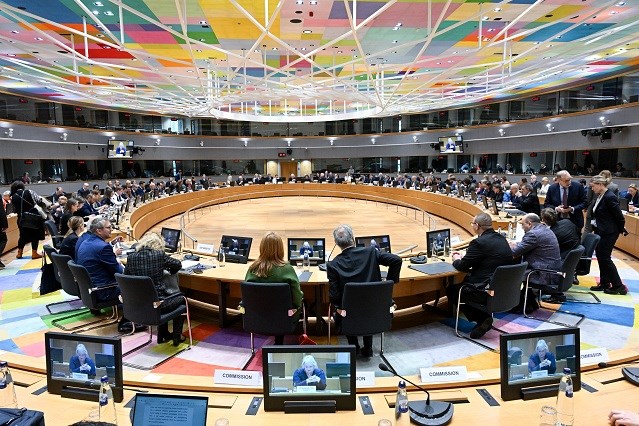
The Minister of Science, Education and Youth, Prof. Radovan Fuchs, PhD, participated in the EU Competitiveness Council for Research and Space, held in Brussels on 9 December 2025.
At the EU Competitiveness Council meeting for Research,
the Council’s general approach to the amendment of the EuroHPC Regulation was approved. The Danish Presidency also presented a
Progress Report on the Horizon Europe package: the Framework Programme for Research and Innovation for the period 2028-2034.
A discussion was held on the strategic priorities for European research and innovation, during which Minister Fuchs emphasized that the continuous and coordinated involvement of Member States is crucial for the strategic direction of the Union and the future Framework Programme. He noted that research and innovation are key tools for strengthening defence, energy independence, and global competitiveness. He also highlighted the importance of reducing the internal innovation gap and supporting efficient, flexible, and transparent governance structure, including the strengthening of EuroHPC and public-private partnerships, with a focus on small and medium-sized enterprises. The Minister concluded that the effectiveness of European partnerships depends on clear, simple, complementary, and transparent modalities for their selection, establishment, and implementation in key areas.
In the afternoon session of the EU Competitiveness Council for Space, the Danish Presidency presented a
Progress Report on the
EU Space Act and held a discussion on the Act.
On that occasion, the Minister stated that Croatia supports the adoption of the EU Space Act, emphasizing its potential to strengthen the competitiveness, resilience, and sustainability of the Union, while also highlighting the need to simplify and clarify certain tasks and processes. He stressed the importance of reducing administrative burdens, ensuring a balanced approach to space activities, dual-use activities, and research and educational activities. He also emphasized the need to ensure a high level of cybersecurity and concluded that the proposed Act represents significant progress, but that consensus and smooth implementation can be achieved only through joint efforts and mutual understanding among Member States.
News